United States National Security Council
Deception PointThe National Security Council is the federal forum in which the novel’s dispute over NASA’s security, funding, and independence reaches the level of presidential policy. Its meeting with intelligence and military leaders makes the conflict concrete: William Pickering presents integration into the intelligence community as a way to protect NASA and finance it, while Zach Herney and Lawrence Ekstrom resist a restructuring that could subordinate scientific work to security priorities. The council’s division foreshadows the institutional pressures behind the meteorite deception, without making the council itself the author of that later plot.
Membership and Institutional Setting
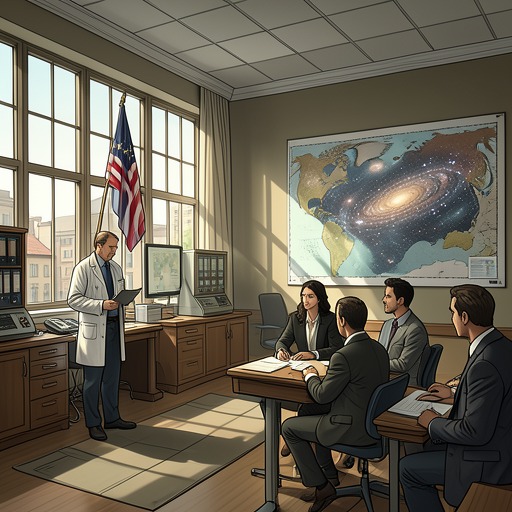
The National Security Council appears as a high-level gathering that brings together the President, the heads of intelligence, the Joint Chiefs, the NASA administrator, and other officials. Pickering recalls one such meeting at the White House, where Marjorie Tench sat across a long oak table from him and the assembled officials. The setting joins agencies with markedly different responsibilities: intelligence officials focus on secrecy and protection of sensitive technologies, while NASA’s leadership defends the scientific purposes and independence of the space agency.
The meeting is not an abstract policy exchange. Its participants possess competing forms of authority over the same technologies and information. Intelligence officials argue that NASA produces a large share of the aerospace, imaging, flight, software, reconnaissance, and telecommunications technologies used by the military and intelligence community, yet remains outside the secrecy rules imposed on other government entities. NASA, by contrast, claims the right to determine its own research priorities and resist military control.
The Proposal to Bring NASA Under the Intelligence Umbrella
The CIA director urges the administration to address what he calls NASA’s continuing security crisis. He points to damaging leaks and argues that security reforms within NASA will remain ineffective while the agency operates outside the intelligence community’s secrecy framework. The comparison is institutional as well as procedural: the military, CIA, NSA, and NRO must follow strict rules for concealing collected data and developed technologies, whereas NASA is not governed by the same umbrella.
The proposed restructuring would place NASA within the military intelligence community, potentially under the Pentagon, CIA, or NRO. The National Security Council begins to split over the idea, with many members siding with the intelligence community. Herney refuses to accept the proposal, which he regards as a threat to the character of the space agency. Ekstrom also opposes it, insisting that NASA’s technologies are developed for nonmilitary, academic purposes. His challenge is not merely over the location of agency authority: the dispute concerns whether NASA’s scientific identity could survive a transfer into a security organization.
Pickering’s Funding-and-Security Argument
Pickering intervenes as a mediator, presenting integration as a practical solution rather than a conversion of NASA into a military research body. He argues that NASA is underfunded, repeatedly forced to seek congressional money, and paying for that shortfall in failed missions. A place in the intelligence community, he suggests, would give the agency access to a substantially larger black budget and relieve it of dependence on Congress. He tells the council that NASA could retain its existing mission and continue its work with more money, stronger security, and discretion over sensitive matters.
The proposal rests on a bargain: protect NASA’s technologies by bringing them under secrecy rules, and provide the funds that Pickering believes the agency needs. He also argues that underfunding itself contributes to weak security. In his account, NASA must publicize its achievements to defend its budget, cut corners on security, and share the cost of joint projects with other countries. The promise of increased resources therefore comes with a substantial institutional cost: the very secrecy that would protect NASA could also narrow public access to its work and make its independence more vulnerable.
Several council members nod in agreement, but Herney tests the limits of Pickering’s assurance. NASA hopes to send a mission to Mars within the next decade; Herney asks how the intelligence community would regard spending a large share of its black budget on a project with no immediate national-security benefit. Pickering answers that NASA would be free to do as it pleased. Herney dismisses that reassurance bluntly. The exchange exposes the unresolved question beneath the proposal: whether NASA could truly preserve its civilian mission while dependent on security institutions for its funding and protection.
Institutional Conflict and Later Consequences
The council’s disagreement establishes a conflict between security and scientific autonomy before the meteorite hoax is explained. Herney’s rejection of restructuring and Ekstrom’s resistance leave Pickering and other security advocates without the institutional arrangement they believe would protect and sustain NASA. Meanwhile, Senator Sedgewick Sexton’s attacks on NASA’s spending give the agency’s funding crisis immediate electoral force. NASA becomes a prominent example in Sexton’s case against government overspending, making its public standing and future resources politically precarious.
Pickering later describes the meteorite deception as a desperate attempt to rebuild NASA’s image and avert its decline. He recalls that he and other military powerbrokers had tried to secure NASA’s survival through incorporation into the intelligence community, but the White House had repeatedly rebuffed the proposal as an assault on pure science. As Sexton’s anti-NASA rhetoric gained popularity, Pickering’s group concluded that a dramatic public triumph was the remaining way to rescue the agency from the prospect of privatization. This connection does not make the council the operational center of the deception; rather, the council’s failed policy debate supplies part of the political and institutional background for the decision Pickering later admits to making.
The episode also complicates the meaning of institutional responsibility in the novel. The council is a place where arguments about secrecy, money, and mission are openly contested, but its members do not share equal control over what follows. Pickering’s carefully framed promise that NASA could remain unchanged sits beside Herney’s suspicion that intelligence funding would impose its own priorities. The later deception emerges from that unresolved tension: the effort to save NASA’s public credibility becomes an act that conceals evidence and damages the trust the agency depends on.